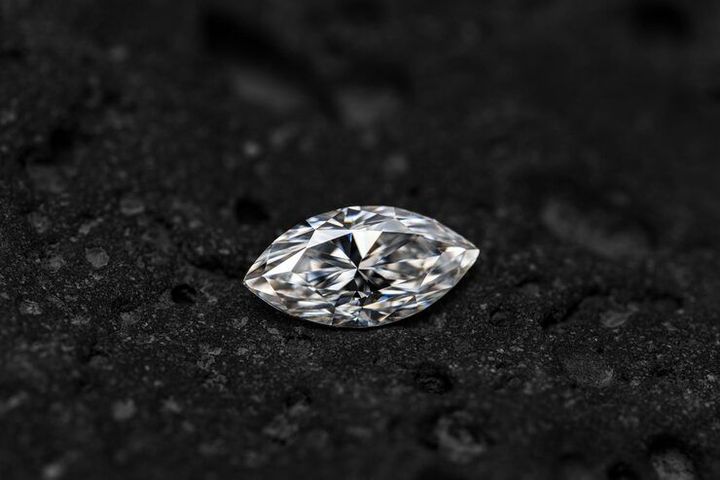
Marquise Lab-Grown Diamond Guide With Color, Clarity, Cut, and Quality Details
A marquise lab-grown diamond is a diamond created in a controlled laboratory environment with an elongated shape, pointed ends, and curved sides. Its outline resembles a small boat or an eye.
The shape is also known as a navette cut and is commonly used in engagement rings, pendants, earrings, and other jewelry designs.
Lab-grown diamonds are made using technological processes that recreate the conditions required for diamond crystal formation. The two primary methods are Chemical Vapor Deposition (CVD) and High Pressure High Temperature (HPHT). Both methods produce diamonds with essentially the same chemical composition, crystal structure, and fundamental optical properties as naturally occurring diamonds.
The marquise shape has a long history in jewelry design. Its distinctive silhouette became associated with decorative jewelry and elongated gemstone cuts, while modern diamond-growing technology made this shape available in laboratory-created material.
How the Marquise Shape Is Designed
The marquise cut typically features two pointed tips and a series of facets arranged to reflect light through the stone. Its elongated outline can create the visual impression of greater length than some other diamond shapes with a similar face-up weight.
Several design characteristics influence its appearance:
Length-to-width ratio: Determines whether the diamond appears narrow, balanced, or broad.
Facet arrangement: Influences brightness, contrast, and light reflection.
Point alignment: Helps establish visual symmetry between the two ends.
Girdle thickness: Affects edge durability and the way the stone fits into a setting.
The final appearance depends on how these characteristics work together rather than on shape alone.
Importance
Why Diamond Quality Matters
Understanding marquise lab-grown diamond quality helps consumers compare stones using measurable characteristics rather than appearance alone. Two diamonds with the same carat weight can look different because their proportions, color, clarity, and facet arrangements vary.
The pointed ends of a marquise diamond also create particular design considerations. These areas can be more vulnerable to chipping if exposed or poorly protected, making the choice of setting important for everyday wear.
People researching engagement rings, anniversary jewelry, or custom jewelry designs may need to understand how the four Cs—color, clarity, cut, and carat weight—affect the finished stone.
The Four Cs of Diamond Evaluation
The four Cs provide a common framework for describing diamond characteristics. They are useful for comparing laboratory-grown diamonds, although they do not capture every aspect of visual appearance.
Color: Describes how much yellow or brown tint is visible in a diamond graded on the conventional color scale.
Clarity: Records the presence, size, position, and visibility of internal inclusions and external blemishes.
Cut: Refers to proportions, symmetry, and finish, which influence the diamond's optical performance. For fancy shapes such as marquise, grading approaches can differ from those used for round brilliant diamonds.
Carat: Measures weight, with one carat equal to 200 milligrams. It does not directly indicate the stone's length, width, or visual size.
A balanced assessment considers all four characteristics alongside the diamond's actual appearance.
Common Challenges When Comparing Stones
Marquise diamonds can display a dark area across the center, sometimes described as a bow-tie effect. This appearance results from the way the facets interact with incoming light and the viewing environment. Its visibility varies from stone to stone.
Other challenges include uneven pointed ends, asymmetrical outlines, excessive depth, and proportions that make the stone appear unusually narrow or broad. Examining the diamond face-up under different lighting conditions can help reveal these characteristics.
Recent Updates
Developments in Laboratory-Grown Diamond Technology
Laboratory-grown diamond production has continued to evolve through improvements in crystal-growth control, process monitoring, and post-growth treatment. CVD and HPHT remain the principal production methods, with manufacturers using different combinations of equipment and process conditions to achieve their intended results.
Advances in production technology have expanded the range of available diamond sizes, shapes, and quality characteristics. Marquise stones can be produced in a variety of dimensions, making proportion selection an important part of jewelry design.
Greater Attention to Disclosure and Grading
Recent industry trends have placed continued emphasis on clearly identifying laboratory-grown diamonds and distinguishing them from mined diamonds. Grading reports, product descriptions, and independent assessments help readers understand a stone's origin and documented characteristics.
Consumers are also paying attention to grading report details, laser inscriptions where present, and the distinction between a laboratory-grown diamond and diamond simulants. Simulants such as cubic zirconia may resemble diamonds but have different chemical and physical properties.
Comparing Marquise Diamond Characteristics
The following table summarizes common evaluation points. These are general comparison guidelines, not universal grading thresholds.
Characteristic | What to examine | Why it matters |
|---|---|---|
Color | Color grade and visible tint | Influences the stone's overall appearance |
Clarity | Inclusion location and visibility | Helps assess visual cleanliness and structural considerations |
Cut quality | Proportions, symmetry, and light return | Influences brightness and visual balance |
Carat weight | Total diamond weight | Provides a standardized weight measurement |
Length-to-width ratio | Relationship between length and width | Determines the outline and overall proportions |
Point protection | Setting coverage at both ends | Helps reduce exposure to accidental impacts |
Grading report | Origin and recorded characteristics | Supports identification and comparison |
Understanding Length-to-Width Ratios
A length-to-width ratio is calculated by dividing a diamond's length by its width. A ratio closer to 1.0 produces a broader outline, while higher ratios generally create a more elongated appearance.
Approximate ratio | General appearance |
|---|---|
1.60–1.75 | Relatively broad |
1.75–1.95 | Moderately elongated |
1.95–2.20 | More elongated |
Above 2.20 | Very slender appearance |
These ranges are illustrative rather than official grading categories. Personal preference, facet arrangement, and the diamond's actual proportions remain important.
Laws or Policies
Diamond Disclosure and Consumer Protection
Rules governing laboratory-grown diamonds vary by country and market. In general, accurate product descriptions should distinguish laboratory-grown diamonds from mined diamonds and should not imply that a laboratory-created stone originated naturally.
Terminology matters because consumers may interpret descriptions such as “natural,” “mined,” “synthetic,” and “lab-grown” differently. Clear identification of the growth origin helps reduce confusion when comparing jewelry products.
Consumer protection frameworks in many jurisdictions address misleading descriptions, inaccurate representations, and the disclosure of material product characteristics. The precise legal requirements depend on the market where the diamond is advertised or sold.
Grading Reports and Identification
Independent gemological laboratories may issue reports describing a diamond's characteristics, including measurements, carat weight, color, clarity, and other identifying details. Some reports also document the growth method or provide information about treatments when applicable.
A grading report should be checked for consistency with the diamond being examined. A report describes the stone evaluated by the laboratory; it does not automatically establish the quality of the finished jewelry setting or the durability of every design choice.
Advertising Accuracy
Descriptions of marquise lab-grown diamonds should use factual, supportable language. Statements about origin, grading, treatments, and quality should match available documentation.
Advertising should avoid unsupported environmental claims, absolute quality claims, and language implying that all laboratory-grown diamonds have identical characteristics. Compliance requirements depend on the applicable advertising and consumer protection rules.
Tools and Resources
Diamond Measurement and Proportion Calculators
Diamond proportion calculators help users understand the relationship between a stone's length, width, depth, and overall shape. A length-to-width calculator is particularly relevant when comparing marquise diamonds with different outlines.
These tools provide mathematical comparisons, but they cannot fully assess sparkle, light leakage, color appearance, or visual symmetry.
Diamond Grading Reports
A grading report can provide standardized information about a laboratory-grown diamond. Useful details include:
Diamond origin and growth method, where documented.
Carat weight and millimeter measurements.
Color and clarity grades.
Cut-related information, symmetry, and polish, where reported.
Treatment disclosures and identifying inscriptions, when applicable.
The grading system and the information included may vary between laboratories. Reports should therefore be interpreted according to the issuing laboratory's stated methodology.
Jewelry Setting Guides
Setting guides explain how different mounting styles hold and protect a marquise diamond. V-prongs can cover the pointed tips, while additional prongs or protective settings may help secure the curved sides.
A bezel setting surrounds some or all of the diamond's perimeter, depending on its design. The choice of setting affects the visible outline, protection, cleaning access, and overall appearance of the jewelry.
Visual Inspection Methods
High-resolution photographs, magnified views, and videos can help reveal differences between diamonds. Images should be examined carefully because camera angles, lighting, magnification, and image processing can change the apparent color and brightness.
When possible, comparing stones under consistent lighting and viewing conditions makes visual differences easier to identify.
FAQs
What Is a Marquise Lab-Grown Diamond?
A marquise lab-grown diamond is a laboratory-created diamond cut into an elongated shape with two pointed ends. It has essentially the same fundamental chemical and crystal structure as a mined diamond.
How Does Color Affect a Marquise Lab-Grown Diamond?
Color grading describes the presence of noticeable body color, commonly on a scale ranging from colorless to increasingly tinted grades. The setting, lighting, and diamond's proportions can influence how its color appears to the eye.
What Clarity Grade Is Suitable for a Marquise Diamond?
The appropriate clarity grade depends on the location, size, and visibility of inclusions. Some inclusions may be difficult to notice without magnification, while others can be visible to the unaided eye or affect structural integrity.
Why Is Cut Quality Important for Marquise Lab-Grown Diamonds?
Cut quality influences proportions, symmetry, and the way light interacts with the diamond's facets. A well-balanced outline and effective light return can contribute to an attractive appearance, although the marquise shape does not have one universally accepted ideal proportion.
Are Marquise Lab-Grown Diamonds Real Diamonds?
Yes. Laboratory-grown diamonds are diamonds rather than simulants because they have essentially the same chemical composition and crystal structure as mined diamonds. Their origin differs, and appropriate grading or identification methods can help distinguish them.
Conclusion
Marquise lab-grown diamonds combine an elongated outline with the material properties of laboratory-created diamond crystals. Color, clarity, cut quality, carat weight, and length-to-width ratio all contribute to their appearance and evaluation. Point protection and setting design are additional considerations because the shape has two exposed tips. Accurate grading documentation and clear origin disclosure help consumers understand the characteristics of individual stones.