Learn How Wire EDM Machines Improve Machining Accuracy and Production Quality
Wire EDM machines, also known as wire electrical discharge machining machines, are precision manufacturing systems designed to cut electrically conductive materials through controlled electrical discharges.
Instead of using a conventional cutting tool that directly contacts the workpiece, a thin electrically conductive wire travels through the material while carefully controlled electrical sparks remove small amounts of material.
The development of wire EDM technology came from the broader field of electrical discharge machining, which was developed to address situations where traditional machining methods could not easily produce intricate shapes in hardened or difficult-to-machine materials. Wire EDM machines became particularly useful because a continuously moving wire can create narrow cuts, sharp internal features, and complex profiles with controlled dimensional accuracy.
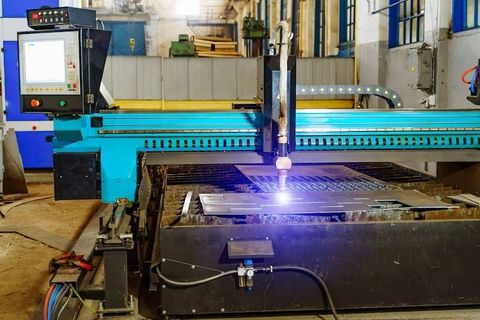
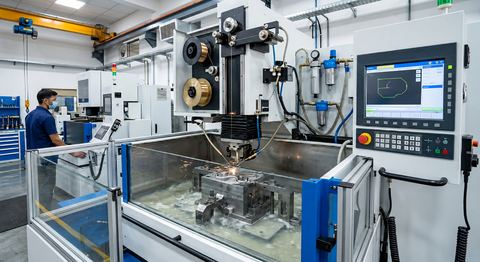
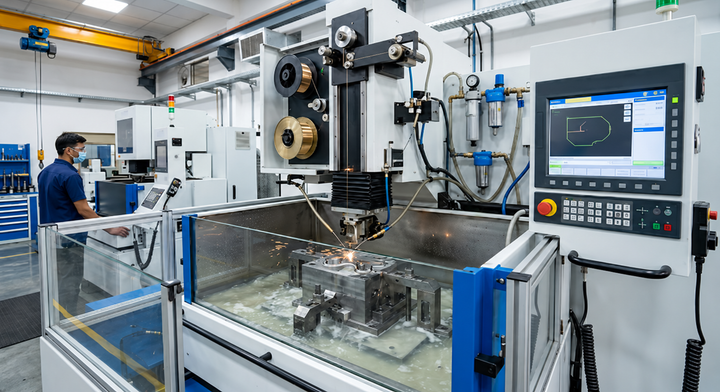
A typical wire EDM system includes a worktable, wire electrode, dielectric fluid system, power supply, CNC control, wire-guiding components, and a positioning system. The workpiece is submerged or continuously flushed with dielectric fluid, while the CNC system controls the movement of the wire along the programmed cutting path.
The wire does not normally touch the workpiece during cutting. Instead, electrical energy creates repeated discharges across a small gap between the wire and material. Each discharge removes a tiny amount of material, and thousands of controlled discharges can gradually create the required geometry.
Wire EDM machines are commonly used for molds, dies, precision components, tooling elements, medical equipment components, aerospace parts, electronics components, and other applications where dimensional control and complex profiles are important.
Importance
Precision in Complex Machining
One of the main reasons manufacturers use wire EDM machines is their ability to produce complicated two-dimensional profiles with controlled dimensions. The process can create narrow slots, small openings, intricate contours, and internal geometries that may be difficult to produce using conventional milling or cutting methods.
Because material removal occurs through electrical discharges rather than direct mechanical cutting, cutting forces are relatively low. This can reduce some of the deformation problems associated with mechanical machining, particularly when working with thin or delicate components.
Accuracy and Surface Quality
Machining accuracy depends on several factors, including machine positioning, wire stability, electrical parameters, thermal conditions, flushing, material properties, and CNC control. Modern wire EDM machines coordinate these variables to maintain a controlled machining gap.
Surface quality can also be adjusted through multiple cutting passes. A roughing pass can remove most of the material, while finishing passes use different electrical conditions to refine the surface.
The following table shows common factors that influence wire EDM results.
| Factor | Influence on Machining |
|---|---|
| Wire diameter | Affects narrow cutting paths and achievable geometry |
| CNC positioning | Controls dimensional accuracy and profile movement |
| Electrical parameters | Influence material removal and surface characteristics |
| Dielectric flushing | Helps remove machining debris |
| Wire tension | Supports wire stability during cutting |
| Multiple passes | Can improve dimensional control and surface finish |
| Material properties | Influence cutting behavior and machining conditions |
Production Quality
Production quality involves more than dimensional accuracy. It also includes repeatability, surface condition, profile consistency, and the ability to maintain specifications across multiple components.
Wire EDM machines can support repeatable manufacturing because CNC programs can control the movement of the wire according to predefined geometries. Once the machining parameters have been established for a particular material and component, the same process structure can be used across multiple production cycles.
This can be particularly important for components that contain small openings, narrow slots, complex contours, or closely controlled dimensions.
Materials and Applications
Wire EDM generally requires electrically conductive materials. Common examples include hardened tool steels, stainless steels, carbide-based materials, copper alloys, titanium alloys, and other conductive engineering materials.
Applications vary across industries. Mold and die manufacturing uses wire EDM for precise cavities, inserts, punches, and profile components. Electronics manufacturing can use it for small conductive components, while aerospace and precision engineering applications may use it for intricate structural or functional parts.
Recent Updates
More Advanced CNC Control
Current wire EDM machines increasingly combine sophisticated CNC control with automated process monitoring. These systems can adjust machining conditions according to factors such as cutting stability, electrical discharge behavior, wire movement, and machining progress.
Improved control systems can also make programming more accessible by integrating graphical interfaces, simulation functions, automatic settings, and geometry-based programming workflows.
Automation and Process Monitoring
Automation has become an important trend in modern precision machining. Wire EDM systems can incorporate automatic wire threading, wire detection, workpiece positioning, machining monitoring, and programmed cutting sequences.
Automatic wire threading is particularly useful because the system can restore the cutting wire after a wire break without requiring the entire process to be manually restarted. This can help maintain production continuity during complex machining operations.
Multi-Axis Machining
Another development is greater use of multi-axis wire movement. Traditional wire EDM primarily produces vertical profiles, while controlled upper and lower wire guides can move independently to create tapered surfaces and three-dimensional profile variations.
This capability expands the range of geometries that can be produced. It is useful for dies, punches, tapered openings, and components requiring different profiles at different heights.
Digital Manufacturing Integration
Wire EDM machines are also becoming more closely connected with digital manufacturing workflows. CAD and CAM systems can generate machining paths from digital component designs, while CNC systems translate those paths into controlled machine movements.
Data monitoring can provide information about machining progress, equipment status, electrical conditions, and process performance. These developments support greater process visibility and can make production planning more structured.
Laws or Policies
Industrial Safety Requirements
Wire EDM machines operate with electrical energy, moving mechanical components, dielectric fluids, and automated systems. Industrial facilities therefore need to follow applicable workplace safety requirements for electrical equipment, machine guarding, emergency controls, operator training, and maintenance procedures.
Specific requirements differ according to the country, industrial sector, facility type, and machine configuration. Operators generally need appropriate training before working with CNC and EDM equipment.
Electrical and Equipment Standards
Manufacturing facilities may also need to follow applicable electrical equipment standards and machine safety frameworks. These requirements can address electrical protection, grounding, emergency stopping systems, control panels, protective enclosures, and safe operating procedures.
The exact standards depend on the jurisdiction and the equipment being installed. Manufacturers and facility managers normally review applicable requirements before commissioning industrial machinery.
Dielectric Fluid and Waste Management
Wire EDM processes use dielectric fluids to control electrical discharge and help remove machining debris. Used fluid, filters, metal particles, and other process residues may require appropriate handling according to local environmental and industrial waste rules.
Environmental requirements can also influence fluid storage, disposal procedures, workplace exposure controls, and recycling practices. Facilities should follow the requirements applicable to their location and material-processing activities.
Tools and Resources
CAD and CAM Software
CAD software is used to create digital component geometries, while CAM software can convert those geometries into machining paths. These tools help engineers visualize profiles, prepare cutting strategies, and identify potential geometry issues before machining begins.
For complex wire EDM applications, simulation functions can help review cutting paths and movement sequences before the physical process starts.
CNC Programming Tools
CNC programming interfaces allow operators to define cutting paths, coordinate movements, machining parameters, and multiple cutting passes. Modern interfaces may include graphical programming features that reduce the need to manually enter every movement command.
Measurement Equipment
Precision measurement is an important part of wire EDM production. Coordinate measuring machines, optical measurement systems, micrometers, profile projectors, and other inspection equipment can be used to verify dimensions and geometry.
Measurement results can then be compared with the original CAD design or engineering specifications.
Process Monitoring Systems
Process monitoring tools can track machining conditions and machine status during operation. Depending on the system, monitoring may include wire tension, electrical discharge conditions, cutting progress, fluid conditions, and machine alarms.
These tools help operators understand whether the machining process is operating within the intended parameters.
FAQs
What are wire EDM machines used for?
Wire EDM machines are used to cut electrically conductive materials into precise profiles. Common applications include molds, dies, tooling components, precision engineering parts, and complex conductive components.
How do wire EDM machines improve machining accuracy?
Wire EDM machines control wire movement and electrical discharge conditions through CNC systems. Low mechanical cutting forces and controlled machining paths can help produce precise profiles, particularly for complex shapes and hardened materials.
Can wire EDM machines improve surface quality?
Yes. Wire EDM processes can use multiple cutting passes to refine a component after the initial material removal stage. Finishing parameters can be adjusted to achieve a smoother and more controlled surface condition.
What materials can wire EDM machines cut?
Wire EDM machines generally work with electrically conductive materials, including various steels, carbide-based materials, copper alloys, titanium alloys, and other conductive engineering materials.
Why is wire tension important in wire EDM machining?
Wire tension helps maintain stability as the electrode travels through the workpiece. Appropriate tension can support consistent wire movement and help reduce unwanted variations in the cutting path.
Conclusion
Wire EDM machines use controlled electrical discharges and CNC-guided wire movement to produce precise profiles in electrically conductive materials. Their ability to process complex geometries, hardened materials, narrow features, and detailed contours makes them an important part of precision manufacturing. Modern developments in automation, multi-axis control, digital programming, and process monitoring are expanding the capabilities of wire EDM systems. Accuracy and production quality depend on coordinated control of machine movement, electrical parameters, wire stability, material characteristics, and inspection processes.