3D Printing Technology Guide: Processes, Accuracy, and Innovation
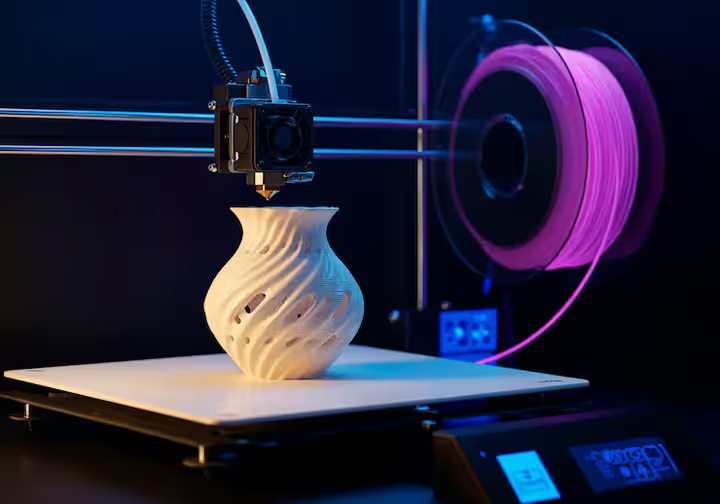
3D printing technology, also known as additive manufacturing, is a method of creating physical objects by building them layer by layer from a digital design. Unlike traditional subtractive methods that remove material from a solid block, this approach adds material only where needed. The concept emerged to address limitations in conventional manufacturing, such as material waste, long development cycles, and restricted design freedom.
At its core, 3D printing exists to translate digital ideas into tangible objects with high precision and repeatability. Engineers, researchers, educators, and manufacturers rely on it to test concepts, customize components, and explore complex geometries that were previously difficult to achieve. Over time, the technology has expanded beyond prototyping into industrial-grade production environments, supporting advanced manufacturing workflows.
Importance: Why 3D Printing Matters Today
3D printing plays a significant role in modern innovation because it directly addresses challenges in speed, flexibility, and customization. Its impact spans multiple sectors, influencing how products are designed, validated, and improved.
Key reasons this technology matters today include:
-
Faster product development cycles through rapid iteration
-
Reduced material usage compared to traditional manufacturing
-
Ability to create lightweight yet strong structures
-
Support for localized and decentralized production models
Industries affected by additive manufacturing accuracy and reliability include:
-
Healthcare, where patient-specific medical devices are produced
-
Aerospace and automotive engineering, where weight optimization is critical
-
Education and research, supporting hands-on learning and experimentation
-
Architecture and construction, enabling complex design visualization
By improving manufacturing precision and enabling digital fabrication workflows, 3D printing helps solve problems related to supply chain rigidity and design constraints.
Recent Updates: Trends and Developments in the Past Year
Over the past year, several notable developments have shaped the evolution of 3D printing technology. In mid-2025, material science advancements expanded the range of printable composites and high-performance polymers, improving durability and thermal resistance. Around March 2025, hybrid manufacturing systems gained attention by combining additive and subtractive processes in a single workflow.
Another visible trend from late 2024 to early 2025 is the integration of artificial intelligence in print preparation and quality monitoring. AI-driven algorithms now assist in detecting print defects early and optimizing layer parameters for improved additive manufacturing accuracy. Sustainability has also become a stronger focus, with research initiatives exploring recyclable filaments and energy-efficient printers.
The table below summarizes recent trends and their focus areas.
| Trend (2024–2025) | Primary Focus | Outcome |
|---|---|---|
| Advanced materials | Strength and heat resistance | Broader industrial use |
| AI-assisted printing | Quality control | Higher accuracy |
| Hybrid systems | Process integration | Improved efficiency |
| Sustainable materials | Environmental impact | Reduced waste |
Laws or Policies: Regulatory and Policy Environment
3D printing technology is influenced by a range of regulatory frameworks, especially where safety, intellectual property, and product standards are concerned. In many countries, manufacturing regulations require printed components to meet the same quality and compliance benchmarks as traditionally produced parts.
Key regulatory considerations include:
-
Product safety and certification standards for industrial components
-
Medical device regulations governing patient-specific printed items
-
Intellectual property laws related to digital design files
-
Export controls on advanced manufacturing equipment and materials
Government-supported programs in several regions encourage research and development in additive manufacturing as part of broader Industry 4.0 strategies. These initiatives aim to strengthen local manufacturing ecosystems while ensuring responsible and compliant use of emerging technologies.
Tools and Resources: Helpful Platforms and References
A wide range of digital tools and informational resources support effective use of 3D printing technology. These resources assist with design preparation, accuracy evaluation, and workflow optimization.
Commonly used tools and resources include:
-
Computer-aided design software for creating printable models
-
Slicing applications that convert designs into machine instructions
-
Online material databases comparing mechanical properties
-
Accuracy calculators for layer height and tolerance planning
-
Educational portals offering additive manufacturing guidelines
The following table outlines typical tool categories and their purpose.
| Tool Category | Purpose |
|---|---|
| CAD platforms | Design and modeling |
| Slicing software | Print preparation |
| Material databases | Property comparison |
| Accuracy planners | Dimensional control |
| Knowledge hubs | Learning and standards |
These resources help users align digital designs with physical outcomes while maintaining consistent quality.
FAQs: Common Questions About 3D Printing Technology
What determines accuracy in 3D printing technology?
Accuracy depends on factors such as printer resolution, material properties, layer height, and calibration. Environmental conditions and design complexity also influence final dimensions.
Is additive manufacturing suitable for large-scale production?
It is increasingly used for low-to-medium volume production where customization and design complexity are priorities. Traditional manufacturing remains dominant for very high-volume output.
How does material choice affect printed results?
Different materials offer varying strength, flexibility, and thermal behavior. Selecting the right material is essential for achieving the desired performance and durability.
What skills are needed to work with 3D printing systems?
Basic skills include digital design understanding, file preparation, and printer operation. Advanced applications may require knowledge of materials science and process optimization.
How is innovation shaping the future of this technology?
Ongoing innovation focuses on improved materials, smarter software, and integrated manufacturing systems, all aimed at enhancing reliability and expanding use cases.
Conclusion
3D printing technology represents a fundamental shift in how objects are designed and produced. By enabling layer-by-layer fabrication directly from digital models, it offers flexibility, precision, and creative freedom that complement traditional manufacturing methods. Recent innovations in materials, software intelligence, and hybrid systems continue to expand its practical applications.
As regulations evolve and supportive policies encourage responsible adoption, additive manufacturing accuracy and consistency are becoming more standardized. With the right tools and informed practices, 3D printing remains a key driver of modern industrial innovation and a valuable component of the global manufacturing landscape.