Factory Line Manufacturing Automation Explained With Systems, Processes, and Applications
Factory line manufacturing automation refers to the use of machines, control systems, sensors, software, robots, and material-handling equipment to perform production activities with limited manual intervention.
It developed from traditional assembly-line manufacturing, where workers performed repeated tasks in a fixed sequence. As factories became more complex, automated equipment became useful for controlling production speed, accuracy, movement, inspection, and coordination.
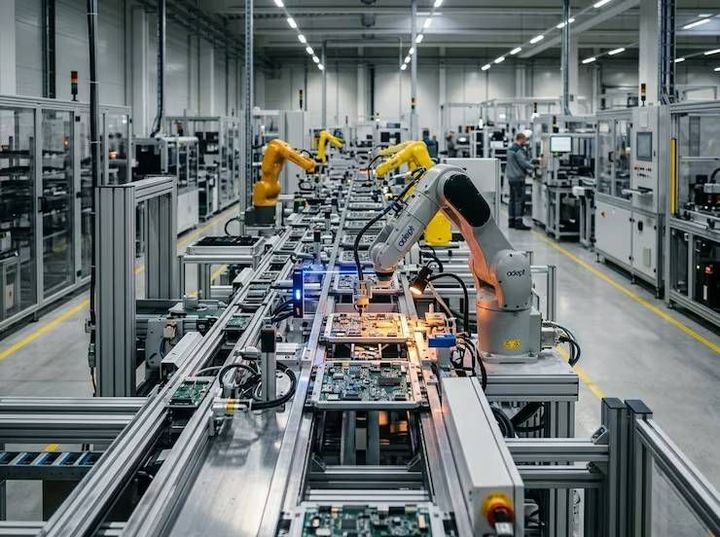
A modern automated factory line can include conveyor systems, robotic arms, programmable logic controllers, industrial sensors, machine vision, automated inspection equipment, and production monitoring software. These components work together so that materials can move through several production stages according to defined instructions.
The basic purpose of factory automation is coordination. A sensor can detect the position of a component, a controller can process that information, and a machine can then perform the next operation. This creates a connected production process rather than a collection of independent machines.
From Assembly Lines to Connected Production
Early production lines focused mainly on repeating mechanical tasks. Later developments introduced programmable controls, electronic sensors, computer-based monitoring, and industrial robots.
Today, factory line manufacturing automation can connect production equipment with digital systems. Data from machines may be collected to identify operating conditions, production quantities, equipment interruptions, and process variations.
This development has also introduced concepts such as smart manufacturing, industrial Internet of Things systems, digital production monitoring, and data-driven process control.
Main Components of an Automated Factory Line
An automated production line commonly contains several layers of equipment.
- Material handling moves components between production stages.
- Sensors detect position, temperature, pressure, speed, or other conditions.
- Controllers process signals and coordinate machine actions.
- Robots perform repetitive movement, assembly, loading, or handling activities.
- Machine vision systems inspect shapes, positions, surfaces, labels, or assembly conditions.
- Human-machine interfaces allow operators to view information and control equipment.
- Manufacturing software records production information and connects machines with broader production systems.
The exact combination depends on the product, production volume, physical layout, and required process sequence.
Importance
Factory line manufacturing automation matters because modern production involves increasingly complex combinations of machinery, materials, information, and quality requirements. Automation can help organize these activities into repeatable processes while allowing people to supervise, adjust, maintain, and manage the production environment.
Problems Automation Addresses
Repeated production activities can involve physical strain, inconsistent timing, material movement challenges, and process variation. Automated systems can perform clearly defined operations repeatedly under programmed conditions.
Automation is also relevant when production requires synchronized equipment. For example, a conveyor can move a component to an inspection station, where sensors confirm its position before another machine begins processing.
This coordination can help reduce unnecessary interruptions and improve visibility into what is happening along a production line. However, automation does not remove every production problem. Equipment failures, incorrect programming, poor maintenance, unsuitable layouts, and sensor errors can still affect operations.
Who Uses Factory Automation
Factory automation is used across many manufacturing areas, including:
- Automotive component production
- Electronics assembly
- Food and beverage processing
- Packaging
- Metal fabrication
- Plastics manufacturing
- Pharmaceutical and laboratory equipment production
- Consumer product manufacturing
- Industrial equipment assembly
The level of automation varies considerably. One facility may automate only material movement, while another may connect nearly every production stage through integrated control systems.
Automation Compared With Manual Production
| Production characteristic | Manual process | Automated process |
|---|---|---|
| Repetitive movement | Mainly performed by people | Often performed by machines or robots |
| Process control | Operator-dependent | Programmable control systems |
| Inspection | Human or separate equipment | Sensors and machine vision can assist |
| Production data | May require manual recording | Can be collected automatically |
| Material movement | Manual handling or basic equipment | Conveyors, robots, and automated systems |
| Process changes | Often adjusted by operators | Programs and control parameters may be changed |
Automation and human work are not necessarily opposing approaches. Many production environments combine automated equipment with human supervision, maintenance, quality control, programming, and process management.
Recent Updates
From 2024 through 2026, factory automation has continued moving toward connected systems, flexible equipment, artificial intelligence-assisted analysis, and greater use of industrial data. Rather than focusing only on individual machines, many manufacturers are connecting production equipment into broader digital production environments.
Connected Factory Systems
Industrial equipment increasingly communicates through industrial networking technologies. Controllers, sensors, robots, and monitoring platforms can exchange information, allowing production conditions to be viewed from centralized interfaces.
This approach supports production monitoring and can make machine information easier to analyze. It also creates additional requirements for network security, data management, system compatibility, and access control.
Robotics and Machine Vision
Industrial robots continue to be used for assembly, material handling, welding, packaging, machine tending, and other structured activities. Collaborative robotic systems are also being developed for environments where people and machines work in nearby areas, subject to appropriate safety design.
Machine vision has expanded alongside robotics. Cameras and image-processing systems can examine components and identify visual differences that may require further inspection.
Artificial Intelligence and Predictive Analysis
Artificial intelligence is increasingly being explored for analyzing machine data, identifying unusual operating patterns, optimizing production parameters, and supporting predictive maintenance programs.
These systems depend on appropriate data quality and process design. Automated analysis does not automatically mean that every prediction is accurate, so production decisions may still require human review and established control procedures.
Flexible Manufacturing
Another current trend is flexible automation. Instead of designing a line around only one product configuration, manufacturers can use programmable equipment and modular production cells to handle product variations.
This approach can be useful where product designs change frequently or where several versions are produced on the same line.
Laws or Policies
Factory line manufacturing automation is shaped by workplace safety, machinery safety, electrical requirements, environmental rules, and data-related policies. The exact requirements depend on the country, industry, machinery type, and workplace conditions.
Machinery and Workplace Safety
Manufacturers and facility operators generally need to address hazards created by moving machinery, robotic systems, electrical equipment, stored energy, hot surfaces, pressure systems, and automated material movement.
Common safety measures include machine guarding, emergency stopping systems, protective devices, warning systems, controlled access areas, maintenance procedures, and operator training.
Electrical and Control Requirements
Automated production lines contain electrical panels, motors, drives, controllers, sensors, and communication equipment. Applicable electrical standards can establish requirements for installation, grounding, protection, wiring, and equipment design.
Control systems may also require safeguards that prevent unexpected machine movement during maintenance or abnormal conditions.
Environmental and Energy Considerations
Some automated factories must comply with rules concerning emissions, waste, water use, noise, hazardous materials, and energy consumption. These requirements vary by production process and jurisdiction.
Automation can also introduce energy-monitoring capabilities, allowing production facilities to measure electricity use by machine, process, or production area.
Tools and Resources
Several categories of tools help people understand, design, monitor, and maintain automated production systems.
Engineering and Simulation Tools
Computer-aided design software can be used to develop equipment layouts and machine components. Factory simulation platforms can model material movement, production sequences, and equipment utilization before physical changes are implemented.
Control and Monitoring Platforms
Programmable logic controller software is commonly used to configure machine sequences. Human-machine interfaces display operating information, alarms, production states, and control options.
Manufacturing execution systems can connect production activities with planning, quality, inventory, and operational data.
Maintenance and Analysis Tools
Condition-monitoring equipment can measure vibration, temperature, pressure, current, and other machine characteristics. Data-analysis platforms can then help identify changes in equipment behavior.
Useful resources may include:
- Factory layout templates
- Production process maps
- Equipment maintenance schedules
- Machine safety checklists
- Automation training platforms
- Industrial networking documentation
- Production monitoring dashboards
- Equipment specification sheets
The appropriate tool depends on the production process, equipment architecture, safety requirements, and level of automation.
FAQs
What is factory line manufacturing automation?
Factory line manufacturing automation uses machines, controllers, sensors, robots, and software to perform and coordinate production activities with limited manual intervention.
How does an automated production line work?
An automated line normally follows a programmed sequence. Sensors provide information about materials or machine conditions, controllers process that information, and equipment performs the next defined operation.
What systems are used in manufacturing automation?
Common systems include programmable logic controllers, industrial robots, conveyor systems, sensors, machine vision, human-machine interfaces, manufacturing execution systems, and industrial communication networks.
What are the applications of factory automation?
Factory automation is used for assembly, packaging, inspection, material handling, machine tending, welding, processing, sorting, and other repetitive or precisely controlled manufacturing activities.
Does automation remove the need for people in factories?
Not necessarily. Automated factories still require people for system design, programming, supervision, maintenance, quality activities, troubleshooting, safety management, and process improvement.
Conclusion
Factory line manufacturing automation combines machines, control systems, sensors, robotics, software, and material-handling equipment into coordinated production processes. Its development has moved from isolated mechanical operations toward connected and data-driven manufacturing environments. Recent developments include flexible robotics, machine vision, industrial connectivity, and artificial intelligence-assisted analysis. Safe implementation continues to depend on appropriate equipment design, human oversight, maintenance, and compliance with applicable requirements.