Commercial Laundry Services Guide With Business Laundry Solutions and Industry Insights
Commercial laundry refers to organized washing, drying, finishing, sorting, and handling of large volumes of textiles for businesses and institutions. Hotels, restaurants, healthcare facilities, fitness centers, educational organizations, manufacturers, and hospitality operators can generate much more laundry than a typical household can process efficiently.
Business laundry solutions have developed to manage these larger textile flows through specialized equipment, planned workflows, trained personnel, quality controls, and resource-management practices. Understanding how commercial laundry works helps readers recognize the equipment, processes, policies, and operational factors that shape modern textile care.
Context
What Commercial Laundry Means
Commercial laundry operations are designed around repeated handling of substantial textile volumes. Instead of processing a small household load, these facilities may handle towels, sheets, uniforms, table linens, workwear, cleaning textiles, and other fabric products according to specific requirements.
The process generally begins with collection and sorting. Textiles are separated according to fabric type, color, soil level, washing requirements, and intended use. Correct sorting helps prevent fabric damage, color transfer, and inappropriate treatment.
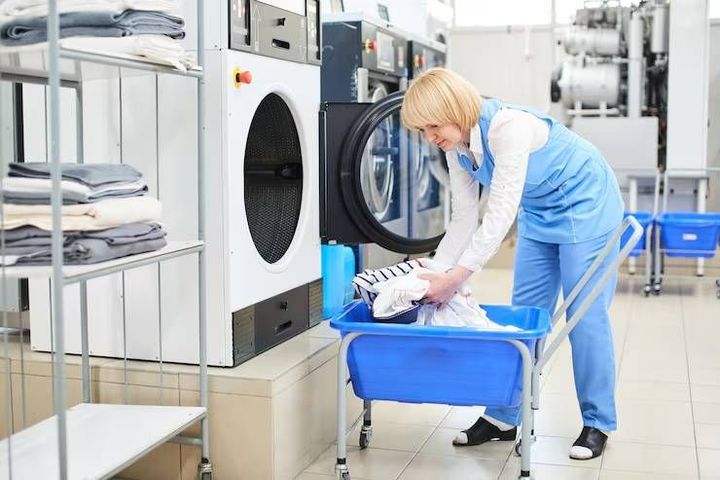
After sorting, textiles move through washing and rinsing stages. Commercial washing machines are engineered for larger loads and repeated operation. Different wash programs can control water temperature, mechanical action, rinse cycles, and chemical dosing according to textile requirements.
Drying is another important stage. Industrial dryers use controlled heat and airflow to remove moisture while limiting unnecessary fabric stress. Some textiles then move to finishing equipment such as ironers, folders, presses, or garment-finishing systems.
How the Industry Developed
Commercial laundry developed from the need to manage textile quantities that were difficult to process manually. As hotels, hospitals, restaurants, factories, and other large organizations expanded, centralized laundry operations became increasingly important.
Modern facilities combine mechanical equipment with workflow planning. Automated controls, programmable washing systems, moisture monitoring, barcode identification, textile tracking, and energy-management systems have gradually changed how large laundry operations are organized.
Importance
Who Uses Commercial Laundry Operations
Commercial laundry affects many organizations that depend on clean and properly maintained textiles. Common users include:
- Hotels and accommodation facilities that process bedding, towels, robes, and related textiles.
- Restaurants and catering operations that handle table linens, kitchen textiles, and uniforms.
- Healthcare facilities that manage specialized textile categories under strict hygiene procedures.
- Fitness centers and wellness facilities that process towels and reusable fabric items.
- Educational institutions that handle uniforms, bedding, sports textiles, and maintenance materials.
- Industrial facilities that manage workwear, protective garments, and reusable cleaning textiles.
Each sector has different textile requirements. A healthcare facility may emphasize contamination control, while a hotel may focus heavily on appearance, fabric preservation, turnaround planning, and inventory accuracy.
Operational Challenges
Large-scale laundry creates several practical challenges. Water consumption, electricity or fuel use, detergent management, equipment maintenance, textile wear, labor planning, and wastewater handling can all influence daily operations.
Another challenge is maintaining consistent processing. If washing temperatures, chemical quantities, drying conditions, or finishing procedures vary substantially, textile quality can become inconsistent. Standard operating procedures help create repeatable results.
Inventory management also matters. Organizations need enough clean textiles for normal operations while avoiding unnecessary accumulation. Tracking systems can help identify missing items, usage patterns, replacement needs, and movement between departments.
Typical Commercial Laundry Workflow
| Stage | Main Activity | Common Equipment or Method |
|---|---|---|
| Collection | Gather used textiles | Carts, bins, textile containers |
| Sorting | Separate textile categories | Sorting tables, identification systems |
| Washing | Remove soil and contaminants | Commercial washers |
| Rinsing | Remove remaining chemicals | Programmable rinse cycles |
| Water Extraction | Reduce moisture | High-speed extraction |
| Drying | Remove remaining moisture | Industrial dryers |
| Finishing | Improve appearance and handling | Ironers, folders, presses |
| Inspection | Check textile condition | Manual or automated inspection |
| Storage | Organize processed textiles | Shelving, racks, inventory systems |
| Distribution | Return textiles to users | Carts and tracking systems |
Recent Updates
Automation and Digital Controls
Modern commercial laundry facilities increasingly use automated controls to improve process consistency. Programmable equipment can manage wash cycles, temperature settings, extraction speeds, drying conditions, and chemical dosing.
Digital monitoring can also provide information about machine utilization, cycle duration, water consumption, energy use, and maintenance requirements. These systems can help operators identify operational patterns without relying entirely on manual records.
Resource Efficiency
Resource efficiency has become an important area of development. Newer laundry equipment can incorporate water-recovery systems, heat-recovery technologies, variable-speed motors, moisture sensors, and optimized wash programming.
The objective is not simply to reduce resource use but to balance resource consumption with textile cleanliness and fabric preservation. Excessive washing, drying, or chemical use can increase textile wear and operational requirements.
Textile Tracking
Barcode and radio-frequency identification technologies are increasingly relevant to larger laundry environments. Tracking systems can record textile movement through collection, processing, storage, and distribution stages.
This approach can improve inventory visibility and help organizations understand textile utilization. It can also assist with identifying items that require replacement or additional inspection.
Specialized Laundry Equipment
Equipment manufacturers continue developing machines for specific textile categories. Examples include high-capacity washers, continuous batch washing systems, tunnel washers, industrial dryers, automated folders, flatwork ironers, and garment-finishing equipment.
Equipment selection increasingly considers capacity, textile type, available space, utilities, workflow, maintenance requirements, and automation capabilities rather than machine size alone.
Laws or Policies
Workplace Safety
Commercial laundry facilities generally operate under workplace safety requirements covering machinery, electrical systems, heat exposure, chemical handling, ventilation, emergency procedures, and personal protective equipment.
Exact requirements vary by jurisdiction. Operators commonly need documented procedures for machine operation, chemical storage, employee training, emergency response, and equipment maintenance.
Chemical Handling
Laundry chemicals can include detergents, builders, bleaches, neutralizers, and fabric-conditioning products. Regulations in many jurisdictions establish requirements for labeling, storage, handling, transportation, and worker protection.
Chemical dosing systems can reduce manual handling and improve consistency. Safety documentation should identify appropriate handling procedures and emergency measures for each chemical category.
Wastewater and Environmental Controls
Commercial laundry produces wastewater containing detergents, suspended material, soil, and other residues. Environmental regulations may establish requirements for wastewater discharge, treatment, drainage, and chemical management.
Facilities may therefore need procedures for wastewater monitoring and appropriate discharge management. Requirements differ according to local environmental frameworks and facility type.
Textile Hygiene
Healthcare and other specialized environments can operate under additional hygiene requirements. Textile handling procedures may address separation of contaminated and processed materials, washing parameters, storage conditions, transportation, and documentation.
Because regulations differ across jurisdictions and industries, organizations generally need to follow the rules applicable to their location and operational category.
Tools and Resources
Laundry Management Software
Laundry management platforms can help record textile quantities, processing stages, inventory movement, equipment activity, and operational data. These systems are particularly useful when large quantities of textiles move between multiple departments or facilities.
Equipment Monitoring Systems
Connected laundry equipment can provide information about machine status, cycle progress, energy consumption, water usage, and maintenance indicators. Operators can use this information to understand equipment utilization and identify unusual operating patterns.
Textile Inventory Templates
Simple inventory templates can track textile categories, quantities, issue dates, return dates, damaged items, and replacement requirements. Digital spreadsheets may be appropriate for smaller operations, while larger facilities may use integrated inventory platforms.
Laundry Capacity Calculators
Capacity calculators can help estimate the required processing capacity based on textile weight, number of loads, operating hours, wash-cycle duration, drying time, and expected daily volume. Such calculations can support equipment planning and workflow analysis.
Maintenance Records
Preventive maintenance records can document inspections, cleaning procedures, component replacement, calibration, and equipment downtime. Regular documentation can help identify recurring equipment problems and support operational planning.
FAQs
What is commercial laundry?
Commercial laundry is the organized processing of large quantities of textiles for businesses and institutions. It can include collection, sorting, washing, extraction, drying, finishing, inspection, storage, and distribution.
How do business laundry solutions work?
Business laundry solutions combine equipment, workflow procedures, inventory systems, textile handling methods, and operational controls. The exact arrangement depends on textile volume, fabric types, hygiene requirements, facility design, and processing schedules.
What equipment is used in commercial laundry?
Common equipment includes commercial washing machines, extractors, industrial dryers, flatwork ironers, garment presses, folders, sorting systems, carts, textile tracking systems, and automated chemical-dosing equipment.
Why is textile tracking important in commercial laundry?
Textile tracking helps organizations monitor where reusable textiles are located and how frequently they are processed. It can support inventory accuracy, loss identification, usage analysis, and replacement planning.
What rules apply to commercial laundry operations?
Rules can cover workplace safety, chemical handling, wastewater management, environmental protection, equipment operation, and textile hygiene. Requirements vary according to jurisdiction and industry, so applicable local regulations need to be considered.
Conclusion
Commercial laundry combines textile handling, industrial washing, drying, finishing, inventory management, and operational planning. Modern business laundry solutions increasingly use automation, digital monitoring, resource-efficiency technologies, and textile tracking to manage larger processing volumes. Safety, chemical handling, wastewater management, and textile hygiene remain important areas of operational control. Understanding these elements provides a general foundation for examining how commercial laundry facilities function across different industries.