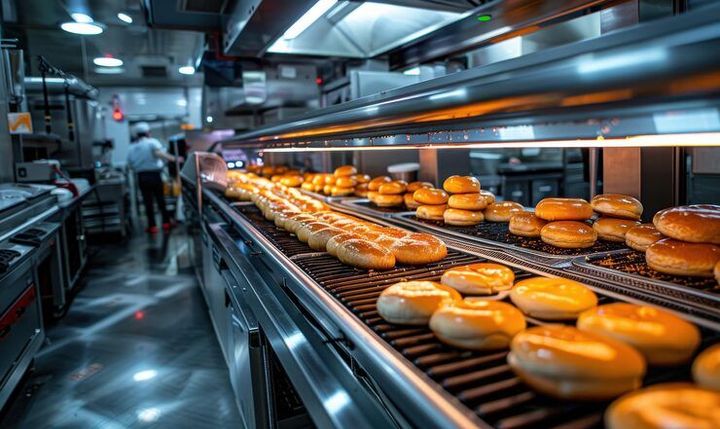
Explore Bakery Cooling Conveyors With Automated Cooling Systems and Production Details
Bakery cooling conveyors are material-handling systems designed to move freshly baked products through controlled cooling stages before further processing, packaging, or storage.
They are commonly used for bread, rolls, cakes, biscuits, pastries, cookies, and other baked products that need time to release heat and moisture after leaving an oven. Automated cooling systems connect conveyors, fans, sensors, drives, and control equipment to create a controlled production flow.
Freshly baked products can be too hot and soft for immediate packaging. If products are packaged while excessive heat or moisture remains, condensation can develop inside the package and affect texture or product condition. Cooling conveyors provide the physical space and movement needed for products to reach an appropriate handling condition.
Early bakery production often relied on racks, trays, or manual movement between oven and packaging areas. As production volumes increased, continuous conveyor systems became more practical. Modern bakery cooling conveyors can now be integrated directly with ovens, depanners, inspection equipment, slicing machines, packaging lines, and other production equipment.
The basic principle is straightforward. Products leave the oven and enter a conveyor system that provides controlled residence time and exposure to surrounding air. Depending on the design, products may move through several conveyor levels before reaching the next production stage.
How Bakery Cooling Conveyors Work
A bakery cooling conveyor usually begins at the oven discharge point. Products are transferred onto a moving belt or other conveying surface and carried through a defined cooling path.
Air movement can be used to increase heat transfer from the product surface. Fans may circulate ambient or conditioned air around the products, while sensors can monitor selected temperature or environmental conditions.
The conveyor length and speed determine how long products remain within the cooling system. A longer conveyor path can provide additional residence time without requiring a large straight section on the factory floor.
Main Components
A bakery cooling conveyor can contain several interconnected components:
Conveyor belts for product movement
Drive motors for controlled belt movement
Multi-level conveyor sections for extended cooling paths
Fans for controlled air circulation
Sensors for temperature and equipment monitoring
Variable-speed drives for conveyor adjustment
Control panels for operating the system
Transfer mechanisms between conveyor levels
Product guides for positioning
Frames and supports for the conveyor structure
The equipment configuration depends on the baked product, production rate, available floor space, cooling requirements, and downstream machinery.
Importance
Bakery cooling conveyors play an important role in continuous bakery production because baked products often need to cool before slicing, decorating, wrapping, or packaging. Cooling is not simply a waiting period; it is a production stage that influences how products can be handled by downstream equipment.
A controlled cooling process can also help reduce interruptions between baking and packaging. When an automated cooling system is connected directly to other production equipment, products can move through the facility with fewer manual transfers.
Product Quality and Handling
Temperature affects the physical properties of many bakery products. Bread and similar products continue to release heat and moisture after leaving the oven. Handling them too early can make slicing, wrapping, or other operations more difficult.
Cooling conditions can also influence crust characteristics, internal texture, and moisture distribution. The appropriate cooling profile depends on the recipe, product size, baking conditions, packaging method, and production process.
Cooling conveyors do not create the same conditions for every bakery product. A thin biscuit, a large loaf, and a decorated cake have different heat-transfer characteristics and therefore require different process considerations.
Production Flow
A bakery production line can contain numerous connected stages. A simplified flow may include:
Ingredient preparation
Mixing
Forming
Proofing where applicable
Baking
Product discharge
Cooling
Slicing or finishing
Inspection
Packaging
Storage
The cooling conveyor connects the baking stage with later processing. Its speed and configuration need to correspond with the output from the oven and the requirements of downstream equipment.
Space and Facility Planning
Cooling conveyors can occupy substantial floor or vertical space. Multi-tier systems can extend the cooling path vertically, allowing longer residence time within a relatively compact footprint.
Facility planning needs to consider access around the conveyor, cleaning areas, inspection points, drive components, electrical panels, and maintenance locations. The relationship between oven discharge and cooling conveyor entry is also important because product transfer should be controlled and consistent.
Recent Updates
From 2024 through 2026, bakery cooling conveyor development has continued to focus on automation, energy management, digital monitoring, hygienic equipment design, and integration with wider production systems. The broader direction is toward connected bakery lines in which equipment can exchange information and coordinate production stages.
Automated Cooling Systems
Automated cooling systems can regulate conveyor movement, fan operation, and selected environmental conditions. Programmable controllers can coordinate these functions according to predefined production settings.
Operators can use human-machine interfaces to monitor conveyor speed, equipment status, alarms, and selected temperature information. Automated controls can also make it easier to adjust the cooling process when different product formats are scheduled.
Multi-Level Conveyor Designs
Multi-level bakery cooling conveyors remain useful where production lines need extended cooling time but available floor space is limited. Products travel through multiple conveyor levels before reaching the discharge point.
The number of levels depends on the required residence time, product dimensions, building height, conveyor design, and access requirements. Transfer points between levels need careful design because products should remain stable while moving between sections.
Digital Monitoring
Connected sensors can provide information about motor status, belt movement, temperature, fan operation, and selected production parameters. This information can be displayed through industrial control systems or production dashboards.
Data collection can also support equipment maintenance. Repeated alarms, motor conditions, belt movement patterns, or other machine information can be reviewed alongside physical inspections.
Energy Management
Fans and conveyor motors consume electrical energy during continuous operation. Modern bakery facilities may use variable-speed drives and automated controls to adjust equipment operation according to production requirements.
Airflow management can also be considered during facility planning. The objective is to provide suitable cooling conditions while accounting for energy use, environmental conditions, and product requirements.
Hygienic Equipment Design
Bakery equipment increasingly incorporates design features intended to make cleaning and inspection more manageable. Accessible surfaces, suitable belt materials, drainage considerations, protected components, and reduced areas where crumbs can accumulate can all influence hygienic design.
The exact hygienic requirements depend on the product, facility, cleaning procedures, and applicable food regulations.
Laws or Policies
Bakery cooling conveyors are affected by food hygiene rules, machinery safety requirements, workplace protection regulations, electrical standards, and environmental requirements. Specific rules vary by country and by the type of bakery operation.
Food Hygiene Requirements
Food-processing facilities generally need procedures for preventing contamination during production. Equipment that comes into contact with food needs suitable materials and cleaning practices for its intended application.
HACCP-based food safety systems may consider the cooling stage as part of the overall production process. Depending on the product, cooling conditions can be monitored because temperature and exposure time may influence food safety and product characteristics.
Cleaning schedules, inspection records, sanitation procedures, personnel practices, and equipment maintenance can form part of a broader food hygiene program.
Machinery Safety
Cooling conveyors contain moving belts, drive mechanisms, transfer points, motors, and other mechanical components. Safety measures may include guards, emergency-stop devices, access controls, warning systems, and protected moving parts.
Maintenance activities can expose workers to mechanical and electrical energy. Appropriate isolation procedures should therefore be established for tasks requiring access to moving or energized equipment.
Electrical and Workplace Requirements
Electrical panels, motors, sensors, drives, and control systems need to be installed according to applicable electrical requirements. Workplace rules may also address noise, access, walking surfaces, emergency routes, and worker interaction with automated equipment.
Requirements differ between jurisdictions, so facility operators need to identify the rules that apply to their particular equipment and production environment.
Tools and Resources
Planning a bakery cooling conveyor involves several technical resources. Equipment specification sheets can provide information about belt dimensions, conveyor speed, motor requirements, cooling capacity, airflow arrangements, product dimensions, and available configurations.
Production-flow diagrams can show how the cooling conveyor connects with the oven and downstream equipment. Facility-layout software can help visualize conveyor routing, multi-level arrangements, access points, cleaning areas, and maintenance clearances.
Useful planning resources include:
Conveyor capacity calculations
Cooling-time worksheets
Temperature monitoring records
Airflow calculations
Equipment specification sheets
Facility layout drawings
Production-flow diagrams
Preventive maintenance schedules
Cleaning checklists
Electrical load calculations
Automation control diagrams
Production monitoring dashboards
A simplified comparison of cooling conveyor configurations is shown below:
| Conveyor Configuration | Main Characteristic | Planning Consideration |
|---|---|---|
| Straight Conveyor | Direct product movement | Floor length |
| Multi-Level Conveyor | Extended cooling path | Building height |
| Spiral Conveyor | Compact vertical movement | Product stability |
| Cooling Tunnel | Controlled airflow environment | Air circulation |
| Modular Conveyor | Adaptable line arrangement | Future layout changes |
| Integrated Cooling Line | Connected production stages | System synchronization |
Temperature monitoring tools can help production teams understand cooling behavior at different points in the conveyor. Digital records can then be reviewed alongside product handling and packaging observations.
Maintenance planning is another important resource. Conveyor belts, bearings, motors, fans, sensors, guides, transfer mechanisms, and control components all require inspection according to their operating environment and manufacturer documentation.
FAQs
What are bakery cooling conveyors?
Bakery cooling conveyors are conveyor systems that move freshly baked products through a controlled cooling period before further processing or packaging. They can use straight, multi-level, spiral, or enclosed cooling arrangements.
How do automated cooling systems work in bakeries?
Automated cooling systems coordinate conveyor movement, airflow, and selected monitoring functions. Sensors and programmable controllers can track operating conditions and allow production teams to adjust defined settings for different products.
Why are bakery cooling conveyors important for production?
Cooling conveyors provide controlled residence time between baking and downstream processes. They can help products reach a more suitable condition for slicing, decorating, inspection, wrapping, or packaging.
What factors affect bakery cooling conveyor design?
Important factors include product size, product temperature, production rate, required cooling time, conveyor speed, airflow, available floor space, building height, hygiene requirements, cleaning access, and downstream equipment.
What types of bakery products use cooling conveyors?
Cooling conveyors can be used for bread, rolls, cakes, biscuits, cookies, pastries, and other baked products. The conveyor configuration and cooling conditions vary according to product characteristics and production requirements.
Conclusion
Bakery cooling conveyors provide a controlled transition between baking and later production stages by moving products through a defined cooling period. Automated cooling systems can coordinate conveyor speed, airflow, monitoring, and integration with other bakery equipment. Recent developments include multi-level designs, digital monitoring, energy management, and increased attention to hygienic equipment design. The appropriate conveyor arrangement depends on product characteristics, production flow, facility space, cooling requirements, and applicable food and machinery regulations.