Commercial Refrigeration Systems Information With Refrigeration Equipment and Technical Details
Commercial refrigeration systems are engineered cooling arrangements used to keep food, beverages, ingredients, medicines, and other temperature-sensitive materials within controlled temperature ranges. They are commonly found in supermarkets, restaurants, food processing facilities, warehouses, convenience stores, hotels, laboratories, and distribution centers.
A commercial refrigeration system combines refrigeration equipment, controls, piping, insulation, and heat-transfer components to move unwanted heat away from a refrigerated space.
The basic principle comes from the refrigeration cycle. A refrigerant absorbs heat from a controlled area and transfers that heat to another location. The process normally involves four major stages: compression, condensation, expansion, and evaporation. These stages operate continuously while the system maintains the required temperature.
Commercial refrigeration equipment has developed from relatively simple mechanical cooling arrangements into electronically monitored systems. Modern installations can include digital controllers, variable-speed components, electronic expansion devices, remote monitoring, improved insulation, and refrigerants selected according to environmental and regulatory requirements.
Main Components
A typical commercial refrigeration system contains several interconnected components. The compressor raises the pressure and temperature of the refrigerant vapor before it moves toward the condenser. The condenser then releases heat and changes the refrigerant into a liquid.
The expansion device reduces refrigerant pressure before the fluid enters the evaporator. Inside the evaporator, the refrigerant absorbs heat from the refrigerated space. Fans, thermostats, sensors, piping, insulation, and electrical controls support this cycle.
Common components include:
- Compressors for circulating refrigerant
- Condensers for rejecting heat
- Evaporators for absorbing heat
- Expansion valves or metering devices for regulating refrigerant flow
- Temperature sensors for monitoring conditions
- Fans for moving air across heat-transfer surfaces
- Controllers for coordinating system operation
- Insulated panels, doors, and piping for limiting unwanted heat transfer
Types of Commercial Refrigeration
Different applications require different refrigeration arrangements. Reach-in refrigerators are commonly used in kitchens and retail environments where staff need direct access to stored products. Walk-in refrigerators and freezers provide larger enclosed spaces for bulk storage.
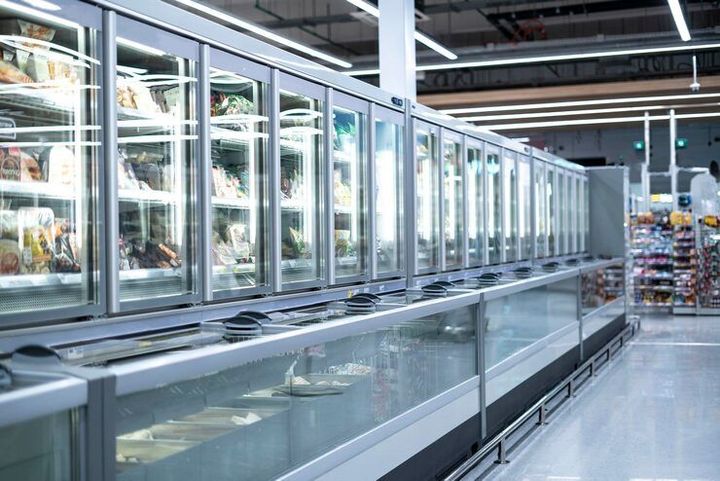
Display refrigeration units combine temperature control with product visibility. Under-counter refrigerators fit beneath work surfaces, while refrigerated preparation tables provide chilled storage near food preparation areas.
Remote refrigeration systems place major mechanical equipment away from the refrigerated cabinets or rooms. Self-contained systems integrate the main refrigeration components into the equipment itself. Centralized refrigeration arrangements can connect multiple refrigerated areas to a common mechanical system.
Importance
Commercial refrigeration is important because temperature directly affects the condition, quality, and usable life of many temperature-sensitive products. A refrigeration failure can result in spoilage, operational disruption, inventory losses, and food-safety concerns. Reliable temperature control therefore plays an important role in commercial kitchens, retail environments, warehouses, and distribution networks.
The topic also affects energy consumption. Refrigeration equipment can operate for long periods, meaning compressor operation, fan operation, lighting, insulation, door openings, and ambient conditions can all influence electricity requirements. Equipment selection and system design therefore involve both cooling requirements and operating characteristics.
Who Uses Commercial Refrigeration
A wide range of organizations rely on commercial refrigeration systems. Food retailers use refrigerated cases, freezers, and cold rooms for different categories of products. Restaurants use refrigerators, freezers, preparation counters, and beverage cooling equipment.
Food processing facilities can require larger systems with multiple temperature zones. Warehouses and distribution centers may use cold storage rooms designed around product volumes, loading patterns, and temperature requirements.
Other users include:
- Hotels and institutional kitchens
- Grocery and convenience retailers
- Food manufacturers
- Cold-storage warehouses
- Beverage facilities
- Laboratories and research environments
- Agricultural and food distribution operations
Temperature Management
Temperature management involves more than selecting a refrigerator with a particular temperature setting. The system must account for the quantity of material entering the refrigerated space, ambient temperature, door-opening frequency, internal heat sources, air circulation, insulation, and required recovery time.
Different applications may require chilled, frozen, or tightly controlled temperature conditions. A temperature monitoring system can record readings and identify deviations from configured limits. This information can support inventory management and help operators investigate unusual temperature changes.
Energy and Equipment Efficiency
Refrigeration efficiency depends on the relationship between the cooling load and the equipment used to remove heat. Factors such as condenser cleanliness, evaporator airflow, insulation quality, refrigerant conditions, compressor operation, and door sealing can influence performance.
Modern commercial refrigeration systems increasingly use electronic controls and variable-speed technologies. These approaches can adjust equipment operation according to changing demand rather than maintaining the same operating pattern at all times.
Recent Updates
Commercial refrigeration technology has been changing in response to energy considerations, refrigerant regulations, digital monitoring, and changing equipment designs. Manufacturers and system designers are increasingly focusing on lower environmental impact refrigerants, improved heat exchangers, electronic controls, and system-level monitoring.
Refrigerant Development
Refrigerant selection has become an important technical consideration. Regulatory programs in many regions are reducing dependence on refrigerants with high global warming potential and encouraging alternatives with lower environmental impact.
Common refrigerant categories include hydrofluorocarbon-based compounds, hydrocarbons, carbon dioxide, ammonia, and other refrigerant options designed for particular applications. Each refrigerant has specific pressure, temperature, safety, and equipment requirements.
Digital Refrigeration Controls
Digital controllers are increasingly integrated into commercial refrigeration equipment. Sensors can measure temperature, pressure, humidity, and other operating conditions. Control systems can then adjust compressors, fans, valves, and other components according to configured parameters.
Remote monitoring platforms can provide dashboards containing temperature readings, equipment status, alarms, and historical data. This creates a more detailed view of refrigeration operation compared with manual temperature checks alone.
Variable-Speed Technology
Variable-speed compressors and electronically controlled fans allow refrigeration equipment to operate at different capacities. Instead of operating continuously at one fixed level, the system can respond to changing cooling requirements.
This approach is particularly relevant in facilities where refrigeration demand varies throughout the day. The actual results depend on system design, operating conditions, equipment configuration, and control settings.
Heat Recovery and System Integration
Some commercial refrigeration installations incorporate heat recovery systems that capture heat removed during refrigeration. Recovered heat may be directed toward applications such as water heating or space heating where the system design permits.
Integrated building controls can also connect refrigeration equipment with ventilation, lighting, energy monitoring, and other building systems. Such integration can provide a broader picture of facility energy use.
Technical Comparison
| Refrigeration Type | Typical Application | Temperature Range | Main Characteristic |
|---|---|---|---|
| Reach-In Refrigerator | Commercial kitchens and retail | Chilled | Direct access |
| Walk-In Refrigerator | Bulk chilled storage | Chilled | Large enclosed space |
| Walk-In Freezer | Frozen storage | Below freezing | Extended frozen storage |
| Display Case | Retail environments | Chilled or frozen | Product visibility |
| Preparation Refrigerator | Food preparation | Chilled | Integrated work area |
| Remote System | Larger facilities | Multiple ranges | Central mechanical equipment |
| Self-Contained Unit | Smaller commercial areas | Chilled or frozen | Integrated components |
Laws or Policies
Commercial refrigeration systems are affected by rules covering refrigerants, electrical equipment, energy performance, food safety, building construction, and environmental protection. The exact requirements depend on the jurisdiction, application, equipment type, and refrigerant used.
Refrigerant Regulations
Environmental regulations increasingly address refrigerant selection, production, importation, use, recovery, and handling. International agreements and regional policies have encouraged reductions in substances associated with ozone depletion and reductions in refrigerants with high global warming potential.
Some jurisdictions apply restrictions to particular refrigerants or equipment categories. Refrigeration operators therefore need to consider the rules that apply to their equipment and location.
Food Safety Requirements
Food-related refrigeration is also connected with temperature-control requirements. Regulations may establish conditions for chilled and frozen storage, temperature monitoring, hygiene, product handling, and records.
The exact temperature limits and documentation requirements vary by jurisdiction and product category. Operators should refer to the applicable food-safety authority for specific requirements.
Electrical and Building Requirements
Commercial refrigeration equipment generally needs to comply with applicable electrical, fire-safety, building, ventilation, and equipment standards. Refrigeration rooms using certain refrigerants may also have additional ventilation or detection requirements.
Standards can address wiring, protective devices, pressure components, equipment construction, refrigerant concentration, and installation practices. Requirements should be checked according to the location and system design.
Tools and Resources
Several tools help people understand and manage commercial refrigeration systems. Refrigeration load calculators can estimate the amount of cooling required for a room or application. These calculations can consider dimensions, insulation, product load, ambient conditions, lighting, personnel, and door openings.
Monitoring Tools
Digital temperature loggers can record temperature readings over time. Refrigeration controllers can display operating conditions and trigger alarms when readings move outside configured limits.
Useful resources can include:
- Refrigeration load calculators
- Temperature monitoring platforms
- Energy monitoring dashboards
- Refrigerant pressure-temperature charts
- Equipment specification sheets
- Electrical and refrigeration design software
- Preventive inspection templates
- Temperature logging forms
- Refrigerant compatibility references
- Equipment operation manuals
System Documentation
Technical documentation is useful for understanding refrigeration equipment specifications. Product documentation can contain compressor capacity, refrigerant type, electrical requirements, operating ranges, airflow information, pressure limits, and installation requirements.
Maintenance records can also provide historical information about temperature performance, alarms, component replacement, refrigerant-related work, and unusual operating conditions. Organized records make it easier to understand changes in system behavior over time.
FAQs
What is a commercial refrigeration system?
A commercial refrigeration system is a cooling arrangement designed for business and institutional applications. It uses components such as compressors, condensers, evaporators, expansion devices, controls, and refrigerant circuits to remove heat from a controlled space.
What types of commercial refrigeration equipment are commonly used?
Common commercial refrigeration equipment includes reach-in refrigerators, walk-in refrigerators, walk-in freezers, display cases, preparation refrigerators, beverage coolers, refrigerated counters, and centralized refrigeration systems.
How does commercial refrigeration equipment work?
Commercial refrigeration equipment generally works through a vapor-compression cycle. The compressor raises refrigerant pressure, the condenser releases heat, the expansion device reduces pressure, and the evaporator absorbs heat from the refrigerated area.
Which refrigerants are used in commercial refrigeration systems?
Refrigerant selection depends on equipment design, operating temperature, safety requirements, environmental rules, and regional regulations. Options can include carbon dioxide, ammonia, hydrocarbons, and various synthetic refrigerants.
Why is temperature monitoring important in commercial refrigeration?
Temperature monitoring helps operators understand whether refrigerated spaces remain within their configured temperature ranges. Continuous or periodic records can also help identify unusual temperature changes and support food-safety documentation where applicable.
Conclusion
Commercial refrigeration systems combine refrigeration equipment, controls, heat-transfer components, insulation, and monitoring technologies to maintain controlled temperatures. Their applications range from small commercial refrigerators to large cold-storage and centralized refrigeration installations. Recent developments include lower-impact refrigerants, digital controls, variable-speed technology, remote monitoring, and greater system integration. Regulations covering refrigerants, food safety, energy performance, electrical systems, and building requirements continue to shape commercial refrigeration equipment and system design.