Vision Care for Seniors Guide With Modern Eye Care and Healthy Vision Tips
Vision care for seniors focuses on protecting eyesight, identifying age-related eye conditions, and supporting safe daily activities as people grow older. Age itself does not automatically mean serious vision loss, but the likelihood of certain eye conditions increases with advancing age.
Cataracts, glaucoma, age-related macular degeneration, diabetic retinopathy, and uncorrected refractive errors are among the conditions that can affect older adults.
Modern eye care combines routine vision assessment, appropriate glasses, disease screening, treatment when required, and practical changes that make everyday environments easier to navigate. The approach is not limited to eyesight alone because vision affects reading, walking, driving, communication, household activities, and social participation.
How aging can affect vision
Some changes are a normal part of aging. The ability to focus on nearby objects can decline, and people may need different reading glasses or updated prescriptions. Other changes, such as persistent blurred vision, distorted lines, flashes of light, sudden floaters, or loss of part of the visual field, can indicate an eye condition rather than ordinary aging.
Older adults can also have several health conditions at the same time. Diabetes and high blood pressure can affect the eyes, making coordination between general health management and eye care important. WHO guidance specifically identifies management of these risk factors as part of maintaining vision in later life.
Common vision concerns in later life
Common concerns include:
- Cataracts, which can make vision cloudy or hazy.
- Glaucoma, which can damage the optic nerve and may progress without obvious early symptoms.
- Age-related macular degeneration, which mainly affects central vision.
- Diabetic retinopathy, which can develop when diabetes affects blood vessels in the retina.
- Refractive errors, which can usually be addressed through appropriate lenses.
- Dry eye symptoms, which may cause irritation, burning, or fluctuating vision.
The causes and severity of vision impairment vary between individuals and regions. WHO identifies refractive errors, cataracts, diabetic retinopathy, glaucoma, and age-related macular degeneration among major causes of vision impairment and blindness worldwide.
Importance
Vision plays an important role in independence and everyday safety. Reduced eyesight can make it harder to recognize steps, read medication labels, prepare food, use digital devices, identify faces, or move safely around the home. WHO notes that vision impairment in older adults can be associated with difficulties walking, social isolation, falls, and fractures.
Why regular eye checks matter
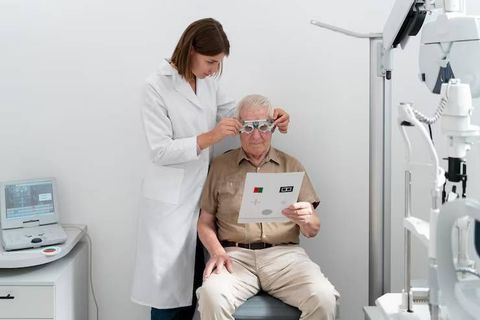
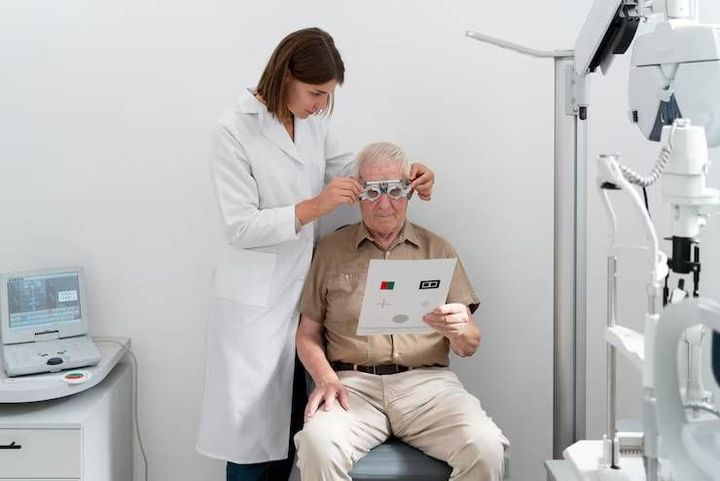
A vision test does more than determine whether someone needs stronger glasses. An eye examination can help identify changes that may require additional evaluation. Some eye diseases can progress before noticeable symptoms appear, so waiting until vision becomes significantly worse may delay detection.
WHO guidance for older adults recommends systematic assessment of distance and near visual acuity together with assessment for eye diseases. Its screening handbook describes screening for people aged 50 and older at intervals of about one to two years, with the exact schedule depending on individual circumstances and health needs.
Healthy vision habits for seniors
Daily habits can complement professional eye examinations. Useful practices include:
- Keeping prescribed glasses clean and using them as directed.
- Taking regular breaks during prolonged reading or screen use.
- Protecting the eyes from strong ultraviolet exposure with appropriate sunglasses and a hat.
- Maintaining good hand hygiene before touching the eyes or handling contact lenses.
- Keeping diabetes and blood pressure under appropriate medical management.
- Avoiding tobacco exposure.
- Maintaining adequate lighting when reading, walking, cooking, or using stairs.
- Keeping floors and pathways clear to reduce fall hazards.
These measures do not prevent every eye condition, but they can form part of a broader approach to healthy vision. WHO guidance for older adults also emphasizes regular eye checks, ultraviolet protection, risk-factor management, and safer home surroundings.
Vision and home safety
Good lighting can make a meaningful difference for someone experiencing reduced contrast or low-light vision. Brighter, evenly distributed lighting can help with stairs, entrances, bathrooms, and reading areas.
High-contrast markings can also make edges easier to recognize. Removing loose rugs, unnecessary furniture, and other obstacles can reduce hazards for people whose vision makes it difficult to notice changes in floor level.
Recent Updates
Modern eye care has increasingly moved toward earlier identification, primary-care screening, integrated health management, and rehabilitation for people living with permanent vision impairment.
New screening guidance
WHO introduced its Vision and Eye Screening Implementation Handbook during the recent period to support practical screening in community and primary-care settings. The guidance includes approaches for older adults and emphasizes early identification of vision problems and pathways for further assessment.
This development reflects a broader shift toward bringing basic vision assessment closer to everyday healthcare rather than relying entirely on specialist facilities.
Greater focus on refractive error
Uncorrected refractive error remains an important cause of vision impairment. WHO's SPECS 2030 initiative has placed greater attention on improving access to appropriate glasses globally, with a target of increasing the proportion of people who have appropriate glasses by 40% by 2030.
For seniors, this is relevant because changing prescriptions can affect reading, mobility, screen use, and recognition of objects at different distances.
Vision rehabilitation and assistive technology
Recent eye-care planning also places greater attention on people whose vision cannot be fully restored. WHO published guidance on integrated vision rehabilitation that addresses assessment, assistive products, workforce development, awareness, and integration into health systems.
Assistive technology can include magnification tools, larger displays, improved lighting, screen-reading functions, high-contrast interfaces, and mobility aids. These tools are intended to support independence when ordinary glasses alone do not adequately address visual limitations.
Laws or Policies
Eye care for seniors is shaped by national healthcare systems, public-health programs, professional standards, and disability-related policies. The exact rules vary by country, so requirements for examinations, treatment, driving, prescriptions, and public healthcare access should be checked against the applicable national framework.
India’s public eye-health framework
In India, the National Programme for Control of Blindness and Visual Impairment, administered through the Directorate General of Health Services, addresses major causes of blindness and visual impairment including cataract, refractive errors, glaucoma, diabetic retinopathy, and corneal conditions.
The National Programme for Health Care of Elderly also forms part of India's broader public-health approach for people aged over 60, with an emphasis on comprehensive healthcare and healthy aging.
These programs demonstrate how senior eye health can be connected with wider public-health planning rather than treated as an isolated issue.
Driving and vision requirements
Many countries have eyesight requirements for driving licenses. These can include standards for visual acuity, visual fields, corrective lenses, and medical assessment in specific circumstances.
Requirements differ substantially between jurisdictions. Older adults should therefore rely on the applicable licensing authority's current rules rather than assuming that a particular vision standard applies everywhere.
Tools and Resources
Modern vision care includes both clinical tools and everyday resources that can help seniors understand and manage visual changes.
Vision screening tools
Standard visual-acuity charts are commonly used to measure how clearly a person can see at a specified distance. Near-vision charts can assess reading-related vision. These tools can indicate that further examination may be appropriate, but they do not replace a comprehensive eye examination.
Digital accessibility tools
Smartphones, tablets, computers, and televisions often include accessibility settings such as:
- Text enlargement.
- Screen magnification.
- Increased contrast.
- Larger interface elements.
- Voice control.
- Screen-reading functions.
- Adjustable brightness.
These features can make digital information easier to read for people with reduced vision.
Home vision checklist
A simple household checklist can help identify areas where visibility may be improved:
| Area | Possible concern | Practical consideration |
|---|---|---|
| Stairs | Poor visibility | Improve lighting and edge contrast |
| Bathroom | Slippery or poorly visible surfaces | Improve illumination and remove obstacles |
| Kitchen | Small labels and controls | Use larger labels and clearer markings |
| Bedroom | Low nighttime visibility | Keep pathways illuminated |
| Reading area | Eye strain or shadows | Use suitable task lighting |
| Digital devices | Small text | Increase text and display size |
Reliable information resources
Useful resources include national health departments, public-health eye-care programs, professional ophthalmology organizations, recognized hospitals, and WHO eye-care publications. WHO maintains resources covering vision screening, eye health, rehabilitation, and integrated care.
FAQs
How often should seniors have an eye examination?
The appropriate interval depends on age, existing eye conditions, general health, medications, family history, and previous examination results. WHO screening guidance describes assessment of older adults around every one to two years as a general framework, while people with known eye conditions may need more frequent monitoring.
What are important healthy vision tips for seniors?
Important healthy vision tips include using appropriate glasses, protecting the eyes from ultraviolet exposure, managing conditions such as diabetes and high blood pressure, maintaining good hygiene, taking breaks from prolonged near work, and keeping the home well lit and free of avoidable hazards.
Does blurry vision always mean a normal part of aging?
No. Some changes are associated with aging, but persistent or sudden changes can also indicate an eye condition. New flashes, a sudden increase in floaters, sudden vision loss, severe eye pain, or a curtain-like shadow across vision require prompt medical assessment.
What does modern eye care for seniors include?
Modern eye care for seniors can include visual-acuity assessment, eye examinations, updated glasses, screening for common eye diseases, monitoring of diabetes-related eye changes, treatment when clinically appropriate, rehabilitation, and assistive technology. The exact approach depends on the individual's condition.
How can families support healthy vision for older adults?
Families can help by keeping appointments organized, improving lighting, reducing household obstacles, checking that glasses are used correctly, and making digital devices easier to read. They can also pay attention to noticeable changes in vision and communicate those changes to an appropriate healthcare professional.
Conclusion
Vision care for seniors combines regular assessment, healthy habits, appropriate correction, disease monitoring, environmental adjustments, and rehabilitation when needed. Aging can increase the likelihood of several eye conditions, but reduced vision should not automatically be considered an unavoidable part of growing older. Recent developments in screening, integrated eye care, accessibility technology, and rehabilitation are expanding the ways older adults can be supported. Public-health programs and healthcare policies also play an important role in improving access to appropriate vision care.