Automotive Welding Robots Basics With Welding Methods, Applications, and Automation Benefits
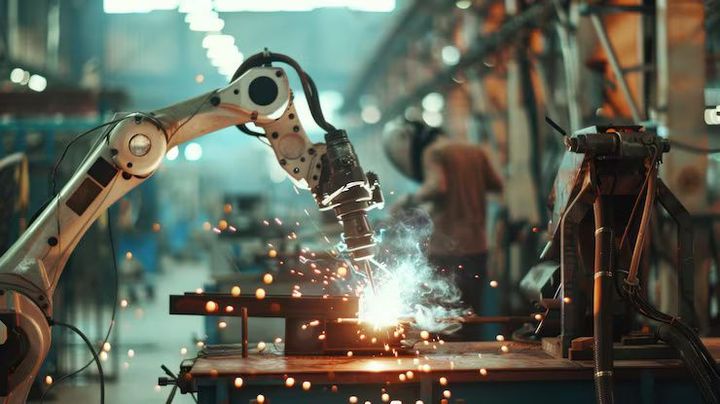
Automotive welding robots are programmable industrial machines used to join metal components during vehicle manufacturing. They combine robotic arms, welding equipment, sensors, controllers, fixtures, and safety systems to perform repeatable welding operations.
Automotive welding robots are commonly associated with vehicle body assembly, chassis production, structural components, and other metal joining processes. Their development comes from the need for consistent weld placement, controlled production cycles, improved workplace safety, and greater flexibility in modern automotive factories.
Context
What Are Automotive Welding Robots?
An automotive welding robot is a programmable robotic system designed to move a welding tool along predetermined paths. The robot does not normally work as an independent machine. It operates as part of a larger robotic welding cell that can include positioning equipment, clamps, sensors, controllers, protective barriers, extraction equipment, and inspection systems.
The robotic arm provides controlled movement across several axes. A welding controller regulates the welding process, while software determines movement, timing, and operating parameters. Fixtures hold vehicle components in the required position while welding takes place.
Automotive welding robots can be configured for different vehicle structures and production requirements. A single production area may contain several robots performing different welding operations in sequence.
How Automotive Welding Robots Developed
Early automotive production relied heavily on manual welding and mechanical fixtures. As vehicle production became more standardized, resistance spot welding and automated equipment became increasingly important.
Industrial robots later introduced programmable movement. This allowed manufacturers to repeat welding patterns with consistent positioning. Modern systems combine robotics with sensors, digital controllers, production monitoring, and automated inspection.
The International Federation of Robotics reported that automotive manufacturing remained an important driver of industrial robot installations, with automotive applications accounting for 45% of industrial robot installations in India during 2024.
Main Components
A typical robotic welding cell may contain:
- Robotic arm for controlled tool movement
- Welding gun or welding torch
- Robot controller for movement and process control
- Welding power source
- Fixtures and clamps for component positioning
- Sensors for detecting component position
- Safety fencing, scanners, or interlocking systems
- Fume extraction equipment where required
- Inspection and monitoring equipment
These components work together to create a controlled manufacturing process rather than simply replacing a manual welding operator.
Importance
Why Automotive Welding Robots Matter
Automotive welding robots are important because vehicle structures require many repeated joining operations. A vehicle body can contain numerous weld locations, and the position, timing, and quality of those welds can influence the structural characteristics of the assembled component.
Automation can help maintain consistent movement and welding parameters across repeated production cycles. It can also reduce the amount of direct human exposure to welding arcs, heat, sparks, fumes, and repetitive physical movements.
The technology also affects how automotive factories organize production. Instead of using one machine for every task, factories can connect multiple robotic cells with conveyors, fixtures, sensors, inspection equipment, and production-control software.
Common Automotive Applications
Automotive welding robots are used in several areas, including:
- Vehicle body-in-white assembly
- Chassis component welding
- Door and hood structures
- Seat-frame production
- Exhaust component assembly
- Battery enclosure structures
- Suspension component manufacturing
- Structural frame welding
- Metal bracket assembly
The specific welding process depends on the material, component design, thickness, required joint characteristics, and production system.
Problems Addressed by Automation
Automated welding can address several manufacturing challenges. Repetitive welding operations can be physically demanding when performed continuously by people. Robotic systems can repeat programmed movements while workers concentrate on supervision, setup, inspection, programming, maintenance, and other activities.
Automation can also improve process traceability. Modern systems may record welding parameters, production cycles, alarms, and inspection information, helping manufacturing teams identify process deviations.
However, automation does not remove every manufacturing challenge. Robotic cells require correct programming, suitable fixtures, routine inspection, safety controls, and technical knowledge.
Welding Methods Used With Robots
Different welding methods can be integrated with automotive welding robots.
| Welding Method | Typical Application | Main Characteristic |
|---|---|---|
| Resistance Spot Welding | Vehicle body panels and structures | Creates localized welds between metal sheets |
| MIG/MAG Welding | Frames, brackets, structural components | Uses a continuously fed wire electrode |
| TIG Welding | Selected precision components | Uses a non-consumable tungsten electrode |
| Laser Welding | Certain precision body and structural applications | Uses a concentrated laser heat source |
| Arc Welding | Various metal assemblies | Uses an electric arc to generate heat |
Resistance spot welding is particularly associated with automotive body assembly because it can join overlapping metal sheets at selected points. MIG/MAG robotic welding is also widely used for components requiring continuous weld paths.
The appropriate process depends on engineering requirements rather than the robot alone. Material type, thickness, joint geometry, accessibility, production speed, heat input, and inspection requirements all influence process selection.
Recent Updates
Greater Use of Digital Production Systems
From 2024 through 2026, automotive robotics has continued moving toward connected and data-oriented manufacturing. Industrial robots are increasingly integrated with production software, sensors, digital monitoring, and offline programming systems.
Recent industry examples show that existing automotive welding robot cells can also be upgraded instead of being completely replaced. In 2026, an automotive welding cell retrofit example described integration of a newer welding robot system with offline programming and access to production data.
Robotics for Changing Vehicle Designs
Automotive factories are also adapting automation to changing vehicle architectures. Different body structures, lightweight materials, electric vehicle components, and battery-related assemblies can require changes to fixtures, welding parameters, robot programs, and inspection procedures.
This has increased interest in flexible robotic cells that can accommodate different production configurations.
Sensors and Process Monitoring
Sensors are becoming more important in robotic welding. Position detection, weld monitoring, vision systems, and production data collection can help identify deviations during manufacturing.
These technologies can support quality control by allowing production teams to examine process information rather than relying only on final visual inspection.
Offline Programming
Offline programming allows robot movements and production sequences to be prepared using software before changes are introduced to the physical production cell. This can reduce disruption during programming activities and make it easier to examine robot paths before implementation.
The usefulness of offline programming depends on accurate digital models, correct tooling information, and proper validation.
Laws or Policies
Indian Robotics Safety Standards
In India, industrial robot safety is shaped by standards and machinery-related regulatory requirements. The Bureau of Indian Standards published a 2024 draft revision aligned with ISO 10218-1 for industrial robot safety requirements. The related Part 2 draft addresses the integration of industrial robot applications and robot cells.
These standards distinguish between the robot itself and the complete robot application or cell. This distinction matters because an automotive welding robot becomes part of a larger system containing welding equipment, fixtures, electrical systems, software, safety devices, and other machinery.
Machinery Safety Requirements
India has also developed machinery safety requirements through the Machinery and Electrical Equipment Safety framework. BIS materials describe requirements involving machinery safety, conformity assessment, technical documentation, and applicable standards. The regulatory framework has been updated through amendments in recent years.
For an automotive welding cell, applicable requirements depend on the equipment, configuration, intended use, and applicable standards. Manufacturers and integrators generally need to examine the relevant requirements rather than assuming that one standard covers every part of a robotic system.
Welding Safety
Welding operations also involve hazards such as heat, electrical energy, sparks, radiation, fumes, and moving machinery. Indian Standard IS 818 addresses safety and health requirements for electric and gas welding and cutting operations.
Safety controls may include guarded areas, emergency stopping systems, interlocks, appropriate protective equipment, ventilation or extraction, warning systems, and controlled access.
Tools and Resources
Robot Programming Software
Robot programming platforms are used to create, modify, simulate, and manage welding programs. Depending on the robot manufacturer and production environment, software can support offline programming, path planning, collision checking, and production-data analysis.
Welding Parameter Tools
Welding parameter references and process calculators can help engineers examine factors such as welding current, voltage, wire feed, travel speed, and heat input. Actual parameters must be established according to the material, welding process, equipment, and qualified production procedure.
CAD and Simulation Platforms
CAD models help engineers design fixtures and examine component geometry. Simulation platforms can be used to check robot reach, tool orientation, movement paths, and possible interference before physical implementation.
Standards Databases
The BIS “Know Your Standard” platform provides access to Indian Standard information, amendments, testing details, and related documentation. It can be searched using an Indian Standard number or keyword.
International standards databases can also help users understand robot safety, welding processes, machinery design, and automation terminology.
FAQs
What Are Automotive Welding Robots?
Automotive welding robots are programmable industrial robots that perform welding operations on vehicle components. They are commonly integrated with welding equipment, fixtures, controllers, sensors, and safety systems.
Which Welding Methods Are Used in Automotive Welding Robots?
Common methods include resistance spot welding, MIG/MAG welding, TIG welding, laser welding, and other arc-based processes. The selected method depends on material, joint design, component thickness, and manufacturing requirements.
What Are the Benefits of Automotive Welding Robots?
Automotive welding robots can provide repeatable movement, consistent process control, reduced direct exposure to welding hazards, production monitoring, and integration with automated manufacturing systems.
How Do Automotive Welding Robots Improve Manufacturing?
They can automate repetitive welding movements and coordinate welding equipment with fixtures and production systems. This can support consistent production cycles and structured process monitoring.
Are Automotive Welding Robots Covered by Safety Standards?
Yes. Industrial robot applications can be subject to applicable machinery and robot safety standards. In India, BIS has developed standards and regulatory frameworks addressing industrial robot safety and machinery requirements.
Conclusion
Automotive welding robots combine programmable robotic movement with welding equipment, fixtures, sensors, controllers, and safety systems. They are used across vehicle body, chassis, structural, and component manufacturing for repetitive and controlled welding operations. Recent developments have emphasized digital monitoring, offline programming, flexible production cells, and integration with modern manufacturing systems. Safety standards and machinery regulations remain important because robotic welding involves both automated movement and welding-related hazards.